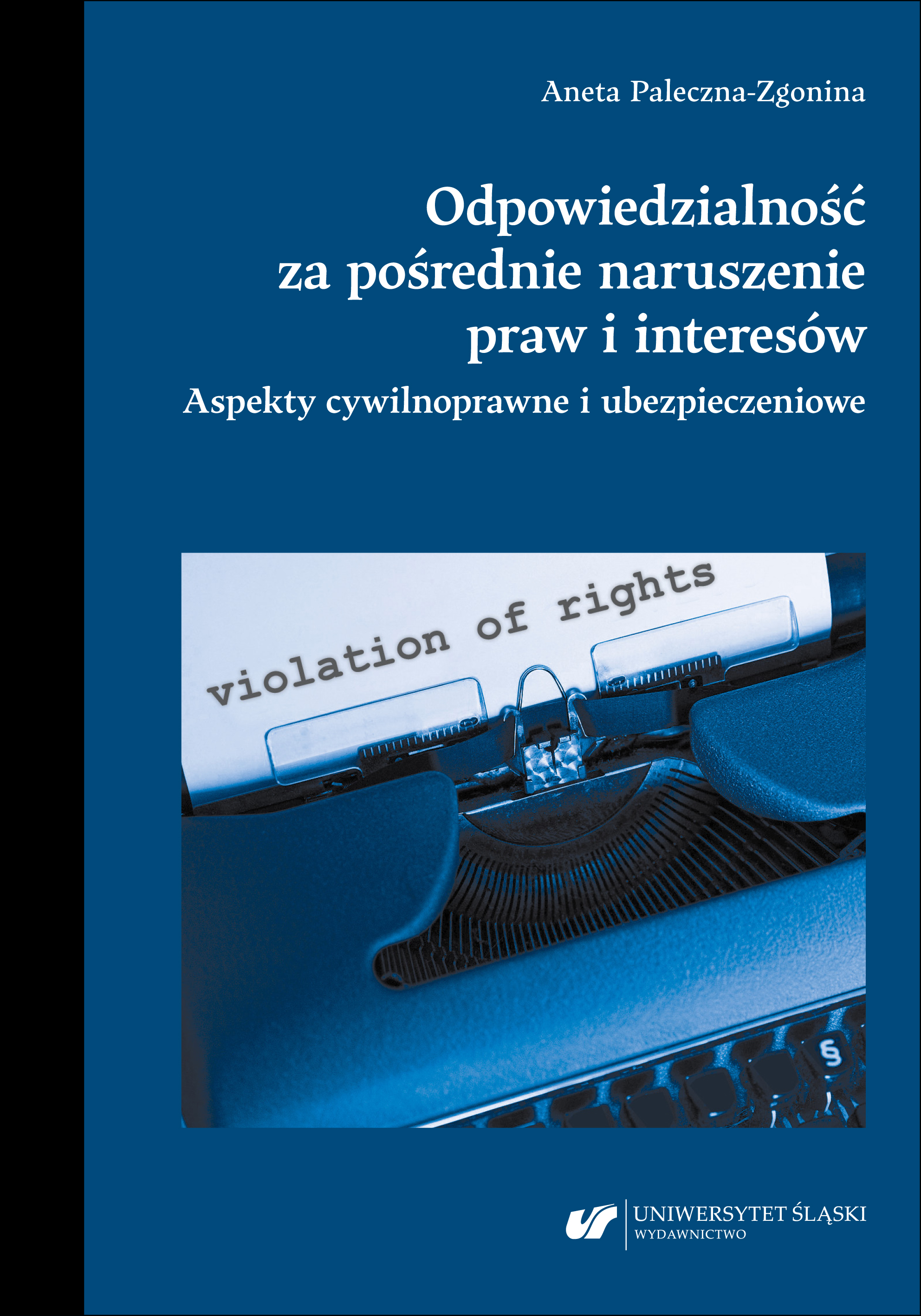
Liability for the Indirect Infringement of Rights and Interests: Civil Law and Insurance Aspects

This work is licensed under a Creative Commons Attribution-ShareAlike 4.0 International License.
Details about this monograph
Synopsis
Indirect violation of rights and interests falls within the scope of liability for damages and its limits. Compensation is provided not only for damage suffered by the directly injured party, but also for damage suffered by an indirectly injured party. Nevertheless, this issue continues to be a challenge for all legislations that have adopted liability for damages. There is no single model for compensating indirect victims. Legal solutions are fragmented, fail to account for economic conditions, and are therefore not systemic. Neither legislators nor legal scholars seem to be counteracting this phenomenon, using a variety of terminology (‘indirect damage’, ‘indirectly injured party’, ‘ricochet damage’). As a result, the level of protection for victims (direct and indirect) must be considered unsatisfactory. The current legal situation is also unsatisfactory from the perspectives of the perpetrator and the insurer. Therefore, the analysis should include the damage suffered (from the perspective of the injured party) and the damage caused (from the perspective of the perpetrator or the liable entity). The lack of predictable and consistent legal solutions may disrupt the balance in economic transactions and contribute to violations of the principle of equality. Meanwhile, the diversity of events that may cause indirect infringement of rights and interests makes it necessary to establish the legal basis for claims by indirectly injured parties and their scope. The scope of compensation for damage should not be presumed. At the same time, the model for compensation for indirect damage should be economically practical.
This research was funded in whole or in part by National Science Centre, Poland,
Grant number 2021/41/N/HS5/02285.


